Barbican Library is an unique library to say the least. It's a public library located on the second floor of the Barbican Arts Center nestled in the finance district in the City of London. The libraries there do a lot with limited space and a limited budget but they're passionate about what they do and that's always encouraging. Geraldine(I think) and Jonathan gave us our tour and it was very obvious that they loved their job and their library, despite projects they can't complete because of budget cuts. Barbican has its own peculiarities as a library and British library. In Britain, the government controls what age children can be allowed to buy/rent videos unlike our suggested rating. For a librarian in the States this would cause a lot of consternation because the ALA would view that as censorship so we were all a bit intrigued. On top of that, said DVDs cost 2.50 to check out but only if they were entertainment dvds; dvds for teaching/learning are free. I may have to look into why this is; I find it very interesting. I can't say I completely oppose it because I understand the possible idea behind, the difference between information and entertainment, but I'd still like to know more.
I really enjoyed their music library; its very strange to have subject special libraries in public libraries; its usually found in an academic libraries because of the specialized student populations. It's a very impressive but small library; they have two digital pianos which people can reserve, plug in headphones and practice. It's awesome.
What I liked the most was the
Barbican Song Index. The staff at the music library worked for a few years to create an index of all the songs/scores that library holds so the patron and librarian can easily find it. From what I've heard about other music libraries where scores/songs are very difficult to find and catalog, this system is time consuming but wonderful. I love seeing how these individual libraries are working on new ways to making information easier to access.
And then we went to St. Paul's Cathedral which was very grand.
Tuesday, July 27, 2010


Monday, July 26, 2010
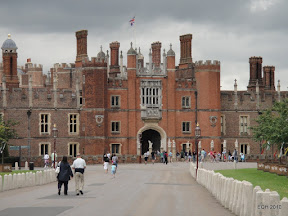
Hampton Court
Hampton Court is famous because of Henry VII, the tudor who killed half of his wives and father to Queen Elizabeth I. But Hampton Court was also home to William III and Mary II during the late 1600s. William III from the Netherlands married Mary II and was generally looked upon as an intruder and foreigner. They did rule together, as the security guard (warder?) was most insistent to explain to me. Unfortunately, Kaitlin and I did not make it to the gardens but I enjoyed walking around the house even though I'm not a fan of baroque architecture -- Sorry Sir Christopher Wren.
It did help make the history much clearer, particularly the political concern about a woman succeeding Henry because he only had one son who was very sickly. Of course, we all know that Elizabeth I eventually came to power and was very much loved and important monarch, but she was the last of a line that had fought a bloody battle to gain power. The explanation of the history and culture of the respected time period. I have a fuzzy understanding of British royal history so their explanations were clarifying. I really wanted a bigger picture though, like where the Tudors fit into the whole scheme and why William and Mary chose Hampton Court.




Sunday, July 25, 2010
Podcast
My Podcast was created with Audacity.
Fair Use law covers the use of the opening song, Let's Go Fly a Kite.
Information about the history of Primrose Hill came from the Royal Parks website.
Sherman, Richard M. and Sherman, Robert B. (1964). Let's Go Fly a Kite.
[Recorded by David Tomlinson, Dick Van Dyke and Chorus]. On Mary Poppins [mp3]. Walt Disney.
The Royal Parks: London's Personal Space (2010).Primrose Hill - from forest to film location.
Retrieved from http://www.royalparks.org.uk/parks/regents_park/primrose_hill.cfm
Fair Use law covers the use of the opening song, Let's Go Fly a Kite.
Information about the history of Primrose Hill came from the Royal Parks website.
Sherman, Richard M. and Sherman, Robert B. (1964). Let's Go Fly a Kite.
[Recorded by David Tomlinson, Dick Van Dyke and Chorus]. On Mary Poppins [mp3]. Walt Disney.
The Royal Parks: London's Personal Space (2010).Primrose Hill - from forest to film location.
Retrieved from http://www.royalparks.org.uk/parks/regents_park/primrose_hill.cfm
Cool Kew
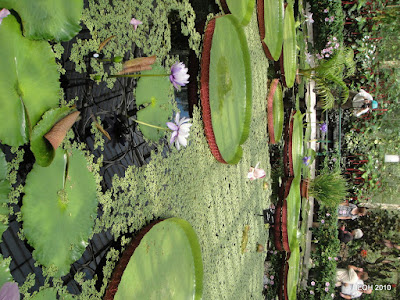
This weekend is the one free weekend we have before we leave London. Tara and I took the opportunity to head out of town to Kew Gardens on Saturday. It was absolutely beautiful with more flowers and plants than we had seen anywhere previous. Kew itself is a tiny little town that was a nice change from superbusy London. The tube lets you off right at the center of town and its only a short walk to Kew. I've actually been really intrigued by Kew Gardens since I read Virginia Woolf's short story by the same name when I was an undergrad. She describes it so beautifully and while I'm sure the gardens have changed since she walked through them, they are still breathtaking and peaceful. There are a few different greenhouses including a Palm House and a Waterlily House. Both of which are filled to the brim with amazing plants that I've never seen before. Tara recognized many of the plants in the Palm House from her home in Hawai'i but for a midwestern like myself, they were very foreign. One of the highlights was definitely the butterfly exhibit in the Princess of Wales Conservatory. There were very beautiful and so much fun to look at. I kept thinking I was going to step on them though; ridiculous but true. London has been an ironically wonderful to explore plants since they have a huge abundance of gardens and around the city. Most of the royal parks were made public which has produced some really wonderful green areas. It definitely makes living in London attractive and bearable. To top off a wonderful Saturday, Tara and I stopped at a great bakery that had the most delicious looking cupcakes, which we brought home to all the roommates. We completely stocked up on carbs: olive filled ciabatta, rosemary and olive oil foccacia and muffins. It was a delicious day!



Friday, July 23, 2010
Regent's Roses
After a full week of major tourist attractions, we took a break and headed for Regent's Park. While this is a tourist attraction as well, its a 410 acre tourist attraction so no one is packed together. It's also a great spot for locals and their families, so it was much more relaxing than the British Museum or Stonehenge. Regent's Park is famous for their gardens and I wasn't disappointed. They were beautiful and obviously well taken-care of, which is nice thing to see in any garden. I was playing with the panorama setting on camera and got some fantastic pictures (see below). The flowers were enticing to photograph but I was really looking forward to flying kites on Primrose Hill. I love flying kites so I was itching for a chance to use my “Tiny Dancer.” Alas, the wind was less the adequate and we all spent most of time running up and down the summit, trying to get lift. I plan on taking my kite to Hyde Park and hopefully it will be windy then. I may try for Primrose Hill again but I'm running out of time for all the things I wanted to do.
The day ended with a trip to Abbey Road. I like the Beatles and their music was a huge part of my childhood, but I can't say that I was blown away by Abbey Road. It might be because I really enjoy the music but knowledge stops there. I don't know much about the group or their history. Not to mention that Abbey Road is a tride-and-true cross walk on a very busy road. I just didn't think it was vale la peňa to stop traffic and I can commiserate with drivers who have to deal with lots and lots of pedestrians. Madison is overrun with students who will not look both ways when they cross the street. However, I really enjoyed the graffiti wall. Thousands and thousands people come and leave their messages and names on the wall outside of the Abbey Road Studio. I think this is much better expression of the Beatles' spirit since they are mostly messages about love. It was a great end to the week.


 -->
-->
Thursday, July 22, 2010
Dr. Who would be so proud
We visited the Prime Meridian today at Greenwich, which is basically a metal line on the ground that is supposed to be 0 0 0. More importantly, its the home of hundreds of years of time-related research. In the "Time Galleries." It's easy to forget that our concept of time is a relatively new invention. For decades, time was kept differently in different places and no one place necessarily matched to another. However, it also wasn't necessary; most towns/villages were concerned with the events going on in their own areas. Once groups started to expand via sea and land, time and direction became very important. The Time Galleries explained how the British set about solving the "longitude problem" in the 18th century after a disastrous shipwreck. It took them years to solve because the direction and clock engineering at the time could not compensate for the natural movement of the ship. Read all about that the Royal Observatory. I think Dr. Who would enjoy this exhibit very much.


Wednesday, July 21, 2010
Somes
Going out to Stonehenge and Salisbury today was such a relief. I love London, I really do, but I find all the people and traffic all the time overwhelming. I always thought I wanted to live in a big city and I'm already starting to rethink things. I've never lived “downtown” before... except in Madison but Madison is only about 100,000 people so its not anywhere near as big as London or Chicago. It was really nice to leave the insane traffic and hundreds of thousands of people for a town set upon chalk. Salisbury would be a great place to spend lots of time. It doesn't have lots of shows or thousands of restaurants but its a good size town with great food, decent shopping and lovely green that isn't overcrowded. I'm probably romanticizing it, but I had one of the best meals so far in a great pub in the center of town.
Stonehenge was, of course, really interesting.. I find it impressive that a group of people thought something was important enough to bring stones that weighed scores of tons to the middle of open field. The meaning of Stonehenge was oddly not bothering me. Its really fun to have your own opportunity to wonder at the meaning of these stones who meant so much to someone sometimes (oh, lots of somes there). It was definitely something.
 |
| From 2010-07-21 |
 |
| From 2010-07-21 |
 |
| From 2010-07-21 |
 |
| From 2010-07-21 |
Subscribe to:
Posts (Atom)