Sunday, August 1, 2010

Je voudrais...

That's how my friend Adam from undergrad taught me to order dinner in french. At least I think that's how it spelled. This crash course in french was courtesy of my whirlwind weekend in Paris. It was amazing. Great food, great friends, great city. The highlight of my weekend was seeing aforementioned friend Adam. We had been great friends in undergrad back at Butler University in Indianapolis, and I was so excited about that chance to spend the day with him and catch up. The internet is a wonderful invention but nothing beats chatting in a plaza about the present, the future, the past, and wondering why, oh why, won't American men be convinced to dress like French men?! It was a fabulous day since we didn't really don anything very intense or touristy. We sat in a plaza, we walked among the shops, we stopped by Notre Dame and he took me to the Jardine du Luxeburg which were so pretty. They were very relaxing and I really wished I could've gone back with a book but it just didn't work out that way. It was wonderful to have that peaceful day since we had done most of the major sightseeing the day as the FSU group. Saturday was complete relaxation and meandering day.

Dinner that evening was very illuminating. First of all the drinks before dinner/lunch that have wine and syrup are called Kirs. They're delicious; I got mine with raspberry but Adam's peach one was very delicious as well. Second, the french version of a salad includes lots of meat and/or an open faced sandwhich. But its the most delicious salad you've ever had. Third, you must get desert. Preferably something with lots and lots of chocolate!

For dinner, Adam and I were joined by a mutual friend Ben. He was an exchange student to Butler a few years ago and he and Adam hang out lot since Adam has arrived in France, not surprisingly. Ben made it some type of random mission to show all the famous and slightly touristy spots I didn't see yet. He dragged Adam and I up to the Basilica, which was absolutely beautiful at night... but was surrounded by super drunk and rambunctious college students. That was not so fun.

Then Ben dragged me down to the Moulin Rouge.. I think he thought it was funny. I've never seen the movie and I don't really understand what the big deal was, so it was anti-climatic to say the least. However, he did make up for by showing me the Opera house. And it an amazingly beautiful building, truly it is. Its not very large but it just feels so grand and brimming with creativity. It was splendid.
I really couldn't ask for a better weekend. I loved seeing my friends and seeing the city that they called home. I loved being able to feel part of the city instead of just a tourist. And I loved being able to reconnect and feel at home with my old friends again.. home is anywhere you feel comfortable, really. And of course, I loved the food. :)

These wonderful experiences did not make the weekend easy. Traveling in any country that's not your own is a struggle to adapt the culture, food and language if its not your own. Language was a particularly difficult one for me. I can read a good portion of french because I'm pretty fluent in Spanish but speaking always trips me up. I've also traveled enough to realize that you have to at least try to speak their language, even if its just "hello." Adam and I discussed this over lunch; Parisians are, on the whole, more than willing to speak English with Americans/British/Candians/etc as long as we try at the French language. I spent the entire weekend wandering saying "bonjour" and "merci" in my horrible french accent and trying desperately to learn the sounds of french. I'm happy I did; I've come back with a better of understanding of French and a feeling of satisfaction since I extended a proverbial olive branch. It's very difficult because its exhausting to think about saying something correctly all the time.

But the Parisians are not nearly as haughty as they are rumored to be. If you try, they will do their best to meet you halfway. Language gaps is one of the most difficult things about traveling because we're all so used to being able to communicate. Its difficult to realize that you are the disadvantaged in a place like Paris because more French people learn at least one other language while Americans often do not learn anything. But the communication goes both way; you can't be expected to fluently speak every language of every country you visit. But they can expect you to try and know the niceities. We do expect something similar from our visitors and even the immigrants who come to live in our country. France was difficult for me because I was embarrassed that I was stumbled over my words and I couldn't communicate. But possibly it was that embarrassment that helped me get along.

Clocking it: Video Assignment

I have a definite obsession with clocks, one I wasn't really aware of until I arrived at the clock exhibition at the British Museum and they continued to pop up in all their glory throughout my trip.
I learned about the relationship between time, navigation and astronomy in the Time Galleries at Greenwhich (much cooler than the arbitrary prime meridian). In Salisbury, the church still has an ancient clock that used to chime every hour to let the town know the time.

So my video become about my interest in clocks because of all the awesome footage I got at the British Museum.

Thursday, July 29, 2010

The British Library Is Not A Lending Library

As a patron, you cannot take a book out of the British Library, you can only read the books in their collection in one of their 11 reading rooms. The British Library is huge; it has eight floors and thousands, maybe millions, of books on site. It has a basement storage area of four floors, each that two floor height. It's an absolutely amazing facility and anything in the library is available for view if you have a reader's card, even the items in the Treasures Collection.


But to get access to anything, you have to have a reader's card. Unlike a public library card, a reader's card is more than just access to the stacks -- its access with a purpose. When you register, you are asked to explain why you want to use the collection and which areas specifically you want to use. This creates a very specific patron pool that divides up into three groups, according to our tour guide: academic, personal and business. Academic is the largest, which is not surprising. Once you have a reader's card you find the book you need, ask the librarian and the librarian brings it to you. This is not a browse-able collection due to the unusual and variety of collection materials. So you get your book, sit there with your pen and paper or computer, read your book and then leave without the book. For most librarians, I think, this must seem like a good way to cut down on circulation -- isn't the point to get the information to the patrons? Well yes, but, the British Library isn't just a public library for people to find information but it also keeps and stores information. It only has one copy of every new book published. It is not a lending library, but it still gets the necessary information. But back to the circulation question, wouldn't the confines of the library decrease the usage. Surprisingly not; according to our tour guide, most rooms are filled between 96%-98% every single day the library is open. I can't imagine many libraries that have circulation statistics like that.

As a reader, you can get just about any book. You can even get the books on display in the Treasures Collection, selected fromTreasures in Full, which includes hand-written letters and stories of Jane Austen, Lewis Carroll, first print editions of Shakespeare's works, original scores by the likes of Mozart, Beethoven and Handel. It is a truly amazing collection. While these items require very special clearance, a reader can check them out and study them if necessary. This is a working library.


All these books come from the stacks below the British Library or their storage facility out in Yorkshire. I was actually lucky enough to see the basement collections. Back at UW I work for the Iberoamerican Studies Bibliographer, Paloma, who was kind enough to put me in touch with a colleague at the British Library. I was given a tour of the storage collection, concentrating on Latin American Colonial and Spanish materials, by Aquiles Alencar Braynar. I was really surprised to see the stacks but it was amazing and completely overwhelming. Even when you see the model, its hard to imagine just how big and expansive the storage area really is. Also, you can definitely hear the tube. Dr. Alencar Braynar showed me the manuscripts area, the large collection of Don Quixote editions gifted to the library and part of the library of Maximillion. Maximillion was once put in power as the "Emperor of Mexico" but was executed in the late 19th century when the Mexican people revolted. One of his aids gave most of his library to the British Library around the start of the 20th century and most of the books are focused on the colonization and revolution in Mexico. A few of these books are being used in the Viva la Libertad! exhibit celebrating the independence of most of Latin America. Mexico's Bicentennial is coming up this fall, which is super exciting.

I'm not doing a very good job at explaining the stacks but it was amazing to see their stacking system which does not follow any specific standard system. They stack them according to size, collection owner, language and maybe, if you're lucky, subject. There are huge horizontal book sections where there are huge books, some of them maps, piled in there own cubbie hole type sections. While it doesn't make sense to the patron, it does make sense for the library and librarians. Since the librarians are the only ones retrieving books, the system doesn't have to be organized LCC or Dewey. This is a very flexible system to allow for all the new books that the British Library receives every year, like the Library of Congress does in the U.S.

Basically, this was the best afternoon ever. :D

Wednesday, July 28, 2010

Tourist of London

The pun is intended. The Tower of London is a favorite of the tourists and today was no exception. This definitely makes sense because some of London's most famous items and people have lived in the Tower of London.
This is the place that holds the kingdom's Crown Jewels and they are amazing, definitely worth the trip if you can get in. Not to mention Sir Walter Raleigh was imprisoned in the "Bloody Tower" (that has the smallest staircase ever!)that his wife eventually turned it into their living apartments. Finally the two princes who are reported to be murdered in Shakespeare's play Richard III were myth no longer as they were found in an evacuation in the mid 17th century. The Tower of London definitely lives up to its reputation as gruesome.

It's a tourist attraction and I know the point is to have tourists but the lines made it really hard to see the exhibits. The Tower of London had thousands of people that created lines trying to see the Crown Jewels and congested stairs. While I'm grateful for the chance to see so many places that are so famous and so important, the Tower of London is no exception, its exhausting and overwhelming to move at such pace. All the information, all the sites, all the time, all the possibilities starting rolling into one big ball that seems like it could crush you. On my part, even though I was tired, cranky and feeling generally overwhelmed, the attractions today became an odd of lesson of "powering through" as Tara says (mostly when we're climbing our stairs). I'm exhausted and overwhelmed but not enough to give up the places and experiences I'm getting. I guess I'm going to just have to embrace my tourist side.

Tower of London Guard

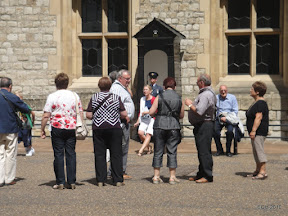
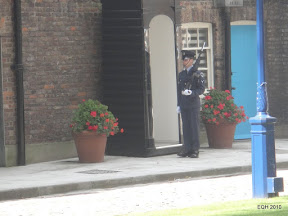
The life of a guard at Tower of London in five pictures.


Tuesday, July 27, 2010

Ciy of London LIbrary: Barbican

Barbican Library is an unique library to say the least. It's a public library located on the second floor of the Barbican Arts Center nestled in the finance district in the City of London. The libraries there do a lot with limited space and a limited budget but they're passionate about what they do and that's always encouraging. Geraldine(I think) and Jonathan gave us our tour and it was very obvious that they loved their job and their library, despite projects they can't complete because of budget cuts. Barbican has its own peculiarities as a library and British library. In Britain, the government controls what age children can be allowed to buy/rent videos unlike our suggested rating. For a librarian in the States this would cause a lot of consternation because the ALA would view that as censorship so we were all a bit intrigued. On top of that, said DVDs cost 2.50 to check out but only if they were entertainment dvds; dvds for teaching/learning are free. I may have to look into why this is; I find it very interesting. I can't say I completely oppose it because I understand the possible idea behind, the difference between information and entertainment, but I'd still like to know more.
I really enjoyed their music library; its very strange to have subject special libraries in public libraries; its usually found in an academic libraries because of the specialized student populations. It's a very impressive but small library; they have two digital pianos which people can reserve, plug in headphones and practice. It's awesome.
What I liked the most was the Barbican Song Index. The staff at the music library worked for a few years to create an index of all the songs/scores that library holds so the patron and librarian can easily find it. From what I've heard about other music libraries where scores/songs are very difficult to find and catalog, this system is time consuming but wonderful. I love seeing how these individual libraries are working on new ways to making information easier to access.
And then we went to St. Paul's Cathedral which was very grand.

Monday, July 26, 2010

Hampton Court

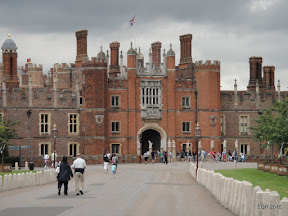
Hampton Court is famous because of Henry VII, the tudor who killed half of his wives and father to Queen Elizabeth I. But Hampton Court was also home to William III and Mary II during the late 1600s. William III from the Netherlands married Mary II and was generally looked upon as an intruder and foreigner. They did rule together, as the security guard (warder?) was most insistent to explain to me. Unfortunately, Kaitlin and I did not make it to the gardens but I enjoyed walking around the house even though I'm not a fan of baroque architecture -- Sorry Sir Christopher Wren. It did help make the history much clearer, particularly the political concern about a woman succeeding Henry because he only had one son who was very sickly. Of course, we all know that Elizabeth I eventually came to power and was very much loved and important monarch, but she was the last of a line that had fought a bloody battle to gain power. The explanation of the history and culture of the respected time period. I have a fuzzy understanding of British royal history so their explanations were clarifying. I really wanted a bigger picture though, like where the Tudors fit into the whole scheme and why William and Mary chose Hampton Court.