This blog is created for FSU Multimedia London Program, Summer 2010. Three weeks in London, England up to my ears in Web 2.0.
Monday, August 9, 2010
Photo Book: European Adventures
Photobook up! I'm pretty happy with it. I used Picasa which wasn't too difficult. I used picture pile on a few of the collages which is very creative for me. Woo hoo!
I'm officially back in Madison and off to work this afternoon. Though currently I'm sitting on the phone to my health insurance company. Super fun. I love REAL LIFE.
Putting together the Photobook was a nice way to remind myself, that yes, it was real. I was just in England as of four days. And now I'm going to work. It's a bit of a 180 but I'm dealing with it. Reverse cultural shock always does me because it sneaks up on me. Ah well, I don't really have time to be time-spatial confused.
Also, this year is Mexico's Bicentennial of their independence, if you didn't get a chance to see the "Viva La Libertad!" exhibit at the British Library. I'm mentioning this because lots of places are going to be having exhibits and events surrounding the Bicentennial. In 1810, Mexico and many other Latin American countries started their quest for independence from the Spanish. HEre is Exploradno Mexico's article as well as the Bicentennial website for Meixco. I mention this because I'm helping my boss prepare for an exhibit on this now that I'm back. Its going to be really fun. I can't wait!
Back to holding... I'm pretty sure I'm on my third repetition of "Hotel California."
Cheers!
Wednesday, August 4, 2010
We're small army
| Back of Buckingham Palace |
Therefore, its almost appropriately ironic that today we had a very individual day. We visited Buckingham Palace, which is only open for two months at the end of the summer when the Queen is in Scotland, so it was a rare and fun opportunity to see inside the palace. Most of us got audio tours and we individually made our way through the Palace. For a group that has spent more time together than some families do on vacation, it was a very solitary tour.
Unfortunately I have no pictures whatsoever as we cannot take pictures inside the Palace. Today was a really good for a Palace tour, actually, as we had our first typical English weather: rainy and chilly with random spots of sun.
Maybe this is London's way of sending us off?
Tuesday, August 3, 2010
Instead we're going to talk about Diana
Hyde Park is full of memorials to this woman, who, by all accounts, was not very popular with the Royal family. She had divorced her husband, Charles, Prince of Wales, and seemed to be pretty independent and feisty. The royal family could have definitely made a fuss about a memorial playground, walk and fountain going up in the name of the this woman, but did not and these three exist for the enjoyment of everyone today. Queen Elizabeth II obviously understands when public opinion and love topples personal pain. Not to mention, it must be very comforting for her sons to see their mother memorialized and loved so much.
I really enjoyed these memorials. The playground was beautiful, lots of fun and very safe. I mention the safety because adults are not allowed into the playground (which is gated) without an adult. It may seem a bit restricting, but it is nice that it creates a safe and comforting environment for children and their parents/guardians/nannies. I definitely wish I had a playground like that when I was a child.
| From 2010-08-03 |
But I truly loved the fountain. It was mentioned that there was some controversy when it was first built since its more of a lazy river type of fountain rather than a large upstanding one. It's made for people and children to go sit by the water and put their feet in on a hot day. Most of us gave it a try and the water was freezing. Too bad it wasn't warmer out. It would've been so comforting on hot feet during the winter. If you've ever been in Lake Michigan, it felt kind of like that. Chilly and will make your feet turn blue after awhile.
| From 2010-08-03 |
| From 2010-08-03 |
What a better way to wind down our trip than a walk through a park that has so well blended the worlds of royals with that of the people.
Monday, August 2, 2010
Oxford Misleading
I have an odd relationship with Oxford. I'm familiar with the schools and dynamics from Lewis and Dorothy L Sayer's Gaudy Night . I don't know the history but I feel like I know the people and atmosphere. Oxford shows up in books that are set in all different time periods; I think I most recently read a mystery where one of the suspects was an Oxford student and it's set in the mid-1800s. Oxford reminds me a bit of Madison actually; the University is an large but somewhat separate part of the town. University society definitely affects town life but they aren't necessarily the same. On top of that, Oxford is a huge draw for tourists. A ridiculous draw for tourists. So far the only place I've seen match lines for Christ Church is Disneyworld and the Tower of London.
There is something impressive and awesome about touring a university that has been around since 1215. We were walking on ground that millions of scholars have walked through before and that makes it seem a bit sacred, even though that isn't the appropriate term for it. I liked walking through the gardens of Christ Church that has a view Magdaline College (which is actually older than Christ Church) and it makes me feel like a scholar. I would love to study in their libraries because there is so much history of study there. That's not saying that they have always been progressive or amazing; scholars often live up to the rumor of being stuffy. Nonetheless, it does feel different, almost encouraging to be able to study in a place thats been devouted to studying for at least 800 years.
That feeling, for me, is somewhat temporary. Its awesome but not permanent. Oxford will always been connected with an idea that is rather contrary to what I've just described. Dorothy Sayers observes, via her characters Lord Peter Wimsey and Harriet Vane while punting on the Thames, that you can't hide within hallowed University halls forever. College or University, particularly when you're young, is a short and blissful time span that is rarely regained. Even if you return for post-graduate education, its never quite the same. Those halls that seemed so impenetrable when you were 20 are actually very permeable and I came to find, like Sayers' characters, that the real world seeps in regardless. For me, in Wisconsin, it comes in the form of healthcare insurance and part-time work. For Sayers' characters, it displays itself in hatred and ignorance of a system that the criminal has. THere was something about going to Oxford and seeing it truly as a tourist attraction, very few students, that stuck this point home. THere are tours for future students at my University, but there are never thousands of people trying to get in to see a College. Oxford is a beautiful and special place but I'm not sure if its as hallowed and protected as maybe once thought.
Sunday, August 1, 2010
Clocking it: Video Assignment
I learned about the relationship between time, navigation and astronomy in the Time Galleries at Greenwhich (much cooler than the arbitrary prime meridian). In Salisbury, the church still has an ancient clock that used to chime every hour to let the town know the time.
So my video become about my interest in clocks because of all the awesome footage I got at the British Museum.
Thursday, July 29, 2010
The British Library Is Not A Lending Library
As a patron, you cannot take a book out of the British Library, you can only read the books in their collection in one of their 11 reading rooms. The British Library is huge; it has eight floors and thousands, maybe millions, of books on site. It has a basement storage area of four floors, each that two floor height. It's an absolutely amazing facility and anything in the library is available for view if you have a reader's card, even the items in the Treasures Collection.
But to get access to anything, you have to have a reader's card. Unlike a public library card, a reader's card is more than just access to the stacks -- its access with a purpose. When you register, you are asked to explain why you want to use the collection and which areas specifically you want to use. This creates a very specific patron pool that divides up into three groups, according to our tour guide: academic, personal and business. Academic is the largest, which is not surprising. Once you have a reader's card you find the book you need, ask the librarian and the librarian brings it to you. This is not a browse-able collection due to the unusual and variety of collection materials. So you get your book, sit there with your pen and paper or computer, read your book and then leave without the book. For most librarians, I think, this must seem like a good way to cut down on circulation -- isn't the point to get the information to the patrons? Well yes, but, the British Library isn't just a public library for people to find information but it also keeps and stores information. It only has one copy of every new book published. It is not a lending library, but it still gets the necessary information. But back to the circulation question, wouldn't the confines of the library decrease the usage. Surprisingly not; according to our tour guide, most rooms are filled between 96%-98% every single day the library is open. I can't imagine many libraries that have circulation statistics like that.
As a reader, you can get just about any book. You can even get the books on display in the Treasures Collection, selected fromTreasures in Full, which includes hand-written letters and stories of Jane Austen, Lewis Carroll, first print editions of Shakespeare's works, original scores by the likes of Mozart, Beethoven and Handel. It is a truly amazing collection. While these items require very special clearance, a reader can check them out and study them if necessary. This is a working library.
All these books come from the stacks below the British Library or their storage facility out in Yorkshire. I was actually lucky enough to see the basement collections. Back at UW I work for the Iberoamerican Studies Bibliographer, Paloma, who was kind enough to put me in touch with a colleague at the British Library. I was given a tour of the storage collection, concentrating on Latin American Colonial and Spanish materials, by Aquiles Alencar Braynar. I was really surprised to see the stacks but it was amazing and completely overwhelming. Even when you see the model, its hard to imagine just how big and expansive the storage area really is. Also, you can definitely hear the tube. Dr. Alencar Braynar showed me the manuscripts area, the large collection of Don Quixote editions gifted to the library and part of the library of Maximillion. Maximillion was once put in power as the "Emperor of Mexico" but was executed in the late 19th century when the Mexican people revolted. One of his aids gave most of his library to the British Library around the start of the 20th century and most of the books are focused on the colonization and revolution in Mexico. A few of these books are being used in the Viva la Libertad! exhibit celebrating the independence of most of Latin America. Mexico's Bicentennial is coming up this fall, which is super exciting.
I'm not doing a very good job at explaining the stacks but it was amazing to see their stacking system which does not follow any specific standard system. They stack them according to size, collection owner, language and maybe, if you're lucky, subject. There are huge horizontal book sections where there are huge books, some of them maps, piled in there own cubbie hole type sections. While it doesn't make sense to the patron, it does make sense for the library and librarians. Since the librarians are the only ones retrieving books, the system doesn't have to be organized LCC or Dewey. This is a very flexible system to allow for all the new books that the British Library receives every year, like the Library of Congress does in the U.S.
Basically, this was the best afternoon ever. :D
Wednesday, July 28, 2010
Tourist of London
The pun is intended. The Tower of London is a favorite of the tourists and today was no exception. This definitely makes sense because some of London's most famous items and people have lived in the Tower of London.
This is the place that holds the kingdom's Crown Jewels and they are amazing, definitely worth the trip if you can get in. Not to mention Sir Walter Raleigh was imprisoned in the "Bloody Tower" (that has the smallest staircase ever!)that his wife eventually turned it into their living apartments. Finally the two princes who are reported to be murdered in Shakespeare's play Richard III were myth no longer as they were found in an evacuation in the mid 17th century. The Tower of London definitely lives up to its reputation as gruesome.
It's a tourist attraction and I know the point is to have tourists but the lines made it really hard to see the exhibits. The Tower of London had thousands of people that created lines trying to see the Crown Jewels and congested stairs. While I'm grateful for the chance to see so many places that are so famous and so important, the Tower of London is no exception, its exhausting and overwhelming to move at such pace. All the information, all the sites, all the time, all the possibilities starting rolling into one big ball that seems like it could crush you. On my part, even though I was tired, cranky and feeling generally overwhelmed, the attractions today became an odd of lesson of "powering through" as Tara says (mostly when we're climbing our stairs). I'm exhausted and overwhelmed but not enough to give up the places and experiences I'm getting. I guess I'm going to just have to embrace my tourist side.
Tuesday, July 27, 2010
Ciy of London LIbrary: Barbican
I really enjoyed their music library; its very strange to have subject special libraries in public libraries; its usually found in an academic libraries because of the specialized student populations. It's a very impressive but small library; they have two digital pianos which people can reserve, plug in headphones and practice. It's awesome.
What I liked the most was the Barbican Song Index. The staff at the music library worked for a few years to create an index of all the songs/scores that library holds so the patron and librarian can easily find it. From what I've heard about other music libraries where scores/songs are very difficult to find and catalog, this system is time consuming but wonderful. I love seeing how these individual libraries are working on new ways to making information easier to access.
And then we went to St. Paul's Cathedral which was very grand.
Monday, July 26, 2010
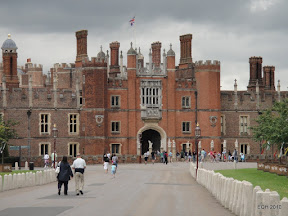
Hampton Court
Sunday, July 25, 2010
Podcast
Fair Use law covers the use of the opening song, Let's Go Fly a Kite.
Information about the history of Primrose Hill came from the Royal Parks website.
Sherman, Richard M. and Sherman, Robert B. (1964). Let's Go Fly a Kite.
[Recorded by David Tomlinson, Dick Van Dyke and Chorus]. On Mary Poppins [mp3]. Walt Disney.
The Royal Parks: London's Personal Space (2010).Primrose Hill - from forest to film location.
Retrieved from http://www.royalparks.org.uk/parks/regents_park/primrose_hill.cfm
Cool Kew
Friday, July 23, 2010
Regent's Roses
Thursday, July 22, 2010
Dr. Who would be so proud
We visited the Prime Meridian today at Greenwich, which is basically a metal line on the ground that is supposed to be 0 0 0. More importantly, its the home of hundreds of years of time-related research. In the "Time Galleries." It's easy to forget that our concept of time is a relatively new invention. For decades, time was kept differently in different places and no one place necessarily matched to another. However, it also wasn't necessary; most towns/villages were concerned with the events going on in their own areas. Once groups started to expand via sea and land, time and direction became very important. The Time Galleries explained how the British set about solving the "longitude problem" in the 18th century after a disastrous shipwreck. It took them years to solve because the direction and clock engineering at the time could not compensate for the natural movement of the ship. Read all about that the Royal Observatory. I think Dr. Who would enjoy this exhibit very much.
Wednesday, July 21, 2010
Somes
| From 2010-07-21 |
| From 2010-07-21 |
| From 2010-07-21 |
| From 2010-07-21 |